


Settling Into a New Home: Embracing the Unfinished
Updated: Jul 9
The perfect storm. That's how I described the status of my spring projects: relocate to Michigan, move my mother into assisted living, and get myself back on track — personally and professionally.
My last update catalogued what happened when I stopped practicing what I preach. As a life coach, I figured I was better than most at keeping tabs on my mental health. Yet, I'd tuned out the warning signals coming from within. It took a meltdown in a hospital chapel to wake me up.

Once we moved, we were armed with a game plan, realistic goals, and an understanding that everything wouldn't go as planned.
It's the start of summer. Let's see how it's going.
The myth of the finished move
Like many people, I had assumed moving was an event with a beginning, middle, and end: packing, getting from the old place to the new one, unpacking. Voila!
I was reminded this spring that packing isn't a straightforward exercise. I was fully prepared that unpacking wouldn't be either. Or that it would pay attention to my calendar.
I'm no longer looking for that "Elvis has left the building" moment to signal the event is over. We've organized ourselves enough to resume most day-to-day routines, but plenty of projects remain unfinished. I've made peace with their limbo status.
That alone feels like progress when navigating a major life transition. I've come to see that achievement isn't about attaining perfect order. It's accepting that life unfolds in messy layers — flux is part of the process. We're moving forward even though so much remains unfinished.
As Ralph Waldo Emerson put it: it's not the destination, it's the journey. My recent journey in moving has taught me plenty. For one thing: make to-do lists in pencil — with suggested rather than hard deadlines.

For another, grasp that the messiness of moving, as that what's most illuminating, especially for what it reveals about who we are or aspire to be. Determined? Flexible? Resilient?
Are we capable of adjusting on the fly, embracing imprecision, and appreciating what remains unplanned? Can we find delight in surprises that serendipity makes possible?.
This embrace of chaos, of what goes unfinished, represents a seismic shift in my thinking. It means I've subdued the field marshal-cheerleader in me that I wrote about last time. The one who chases perfection, and pushes herself beyond reasonable standards to achieve the unachievable.
That's not to say my new attitude translated into a problem-free move. Or that I took whatever the fates dished out without pushing back. I just picked my battles when it came to unpacking and settling in.
Why unpacking takes longer than we think
Back in mid April, while waiting for a pair of burly movers to unload our rental truck, we sat in folding chairs in the middle of an empty living room, admiring the expanse of uncluttered, wood floors.
Within hours, those floors were covered with a maze of box towers — and makeshift scaffolding built of end tables, mops, lamps, rolled-up rugs, and sofa cushions.

The movers had been mindful of what labels there were, depositing boxes to their intended destinations. That worked for those I'd carefully packed early on in the process.
Those in the kitchen looked neat and stacked in several columns made of cardboard. They were also blocking the cupboards and drawers they were intended to fill.
Despite having sketches of where everything should go, we still faced hours of labor to discover which items fit where — and why.
An occupational hazard of being a former professor and professional writer is owning lots of books. I'm careful to pack them tightly in small, sturdy boxes that stack easily and advertise their weight — usually not exceeding 25 pounds.

Since the movers tossed them around like tissue boxes, they weren't the issue. It was the sheer volume of everything coming off the truck. The steady march of containers through the front door that quickly filled up rooms, spilled into hallways, even ending up in bathrooms.
Those boxes I packed in a hurry at the end would prove especially vexing. Their labels gave vague clues as to their contents. That meant cracking them open and traversing the place looking for suitable homes for such a mishmash of stuff.
A few mishaps forced us to put makeshift first-aid kits on both floors. The box cutter got dangerously dull with repeated use. And any one of the four pairs of scissors we had laying around were rarely handy. I should have strapped a pair in a holster on my hip like a gunslinger ready for high noon.
Why moving forces us to rethink what we own
The bigger picture for anyone who's ever moved — whether dealing with a jammed trunk or an overflowing moving van — is to wonder: where did we get all this stuff?!
I even found two boxes I hadn't opened since the last move. They were full of photo albums and old papers I hadn't set eyes on in years.
Most of us can attest to just how daunting it is to sort through all the stuff we've accumulated. And we often adopt an "out of sight, out of mind" approach until moving forces a showdown.
Whether it's a couple of years or many decades, our belongings grew, multiplied, and outsized the space available for them. And who really follows the "one in, one out" rule so many die-hard minimalists advise: bring in something new only if we can let go of something we already have.

Most of us want to take into the future only what suits who we are — or aspire to be. We don't want anything that doesn't serve that vision.
But how to know which items among our belongings qualify? Or how to get rid of what doesn't?
Deciding which stuff to keep can prompt a crisis of identity. Are we who we think we are without our stuff?

Are we the sum total of our memorabilia, trophies, family heirlooms, and concert T-shirts that prove we were "there" then and still here today?
How many photo albums do we need to preserve the memories of people and places we love? We learn that they live on in our hearts and minds.
On closer inspection, these relics from the past can also make clear what we need to leave behind.

Too much of anything can begin to feel oppressive. It's hard to pick favorites when they're all locked away in attics and garages.
And do they really mean that much to us if they're stashed somewhere we might only visit someday?
The problem comes to a head when we're trying to make space — literally and figuratively — to accommodate major life changes.
Psychologist Joseph Ferrari, a well-known researcher, argues that clutter isn't measured by how full our homes look — but by whether our possessions begin interfering with the lives we want to live.
Whether in our existing homes or settling into new ones after a move, we eventually have to face the issue of editing what belongs to a past we want to outgrow — or to a present we hope to outpace.
When storage becomes emotional baggage
On a previous move, we put our overflow in a storage unit we rented. After paying a sizable fee for several months, we eventually cleared it out. We gave much of it away. It became apparent that what was being stored hadn't been considered valuable enough to include in our new place, so why were we paying to hang on to it?

There were a lot of hand-me-downs and "just in case" items we thought we might need — but obviously didn't after months had passed.
It was like overpacking for a vacation. Such "maybe" items can weigh down a suitcase and make it harder to navigate planes, trains, and automobiles. Better to buy what we need when necessary and save on baggage fees — and a sore back.
The late, great comedian George Carlin offered a memorable take on the issue of too much stuff.
"That's all our houses are is a pile of stuff with a cover on it," he observed.
He was particularly scornful of storage units. "Imagine that ... a whole industry based on keeping an eye on [our] stuff!"
Dana K. White, a well-known guru on decluttering, uses the "container method" to help us wrap our heads around the idea of limited space. It's different than trying to decide what we keep by what's most precious. It's the limitations of space, pure and simple.
As she notes, a shelf, drawer, closet — our entire house — are simply containers of different sizes. When they're full, they're full — even functioning best when there's room to spare. She warns that it should never be the other way around: when we buy more containers to hold more stuff.
The unexpected costs of starting anew
Ready or not, it was time to set priorities for projects that brought us closer to resuming some semblance of daily life. That included setting strict limits on what we should and could reasonably accomplish on any given day.
The first project was to put our bed together so we could stop sleeping on blow-up mattresses. Although we had to wait for the Sleep Number technicians to reattach the wires, we were able to sleep on the mattresses resting on the floor. They felt downright luxurious — not losing air in the middle of the night and getting lumpy.

Second, we set up basic operations in the kitchen to be able to brew fresh coffee and prepare fresh meals. It was another thrill to use real dishes instead of paper plates.
Each room presented its own challenge before they could become fully functional. For some, that meant a fresh coat of paint and new window treatments. Others required more creative solutions — and cash outlay.
The screen on the sliding patio door fell off its track on our first attempt to reach the balcony. We had to pay to get that fixed. We discovered the switch to turn on the gas fireplace didn't work. We opted to postpone that fix until it's cold outside. Other projects also got put on a B-level to-do list. We even created a "someday" list to get around to doing next year and beyond.
Projects like replacing the counter tops in the kitchen. We discovered a two-inch blistering hole in the most visible area possible. It had been covered up during the inspection by placemats no one thought to peek under.

We had more pressing needs, like getting a new washer and dryer. They were advertised as "smart" with intelligence sensing with a corresponding app. We've yet to explore any option other than a basic cycle. That learning curve also added to the "someday" list.
Most of the kitchen appliances are more than 15 years old and will have to do for now. We've come to accept that the stove is fussy, the refrigerator makes weird noises at night, and the dishwasher stopped smelling like rotten eggs once we deep cleaned it.
Our furnace and AC system are well past their sell-by dates. The technician we called in referred to them as "geriatric." We should expect to have to replace them sooner rather than later, he warned.
Adapting to life in a new place
An expense that became obvious soon after arriving in Michigan — but one we hadn't really anticipated financially — was having to get a second car.
While living in the DC metro area for the past two years, we took advantage of the transit system connecting the district to southern Maryland and northern Virginia — better known as the DMV.

Our Detroit area home makes good on its famous nickname: the "motor city." Cars rule here. There's little mass transit outside a few limited bus lines. An elevated "people mover" system and Q-line streetcars exist, but they're largely confined to the downtown area.
Like other major cities, Detroit lost much of its population to fast-growing suburbs, which now encompass six counties for a combined population of 4.3 million.
Many blame the auto industry for blocking attempts to create a large-scale transit system that didn't need cars. It's left natives and newcomers alike dependent on cars to get around. Us included.
Bringing color into our home and our lives
Painting each room in the house started back in March and remains ongoing. Before we closed on the condo, we made two trips to Michigan — just a 10-hour drive — to paint as many walls as we could while the space was empty.
Remember, only Mike toured the home back in January — with me following along on FaceTime. That day was snowy and the condo's shades were drawn. There was little indoor lighting besides dusty ceiling fans and dim overhead lights. It was difficult to discern what color the walls actually were.
The realtor's photos, which had been posted online with the original listing, weren't of much help either. They used a wide-angle lens and artificial lighting to make everything appear bigger and brighter than they actually are.
As I walked through the door for the first time in person, my heart sank. The walls weren't the light, airy gray I had assumed. They were a muddy, mid-toned gray up against random accent walls in an even darker shade of charcoal. I knew I couldn't live with these walls for too long without feeling claustrophobic, maybe even a bit depressed.

We painted most of the walls a warm white — Benjamin Moore's Chantilly Lace, to be specific.
Then we added a few strategic accent walls throughout the house for contrast and interest. Here, we used another Benjamin Moore paint, Franklin Lakes — an homage to the nearby lakes. We used this color on the fireplace wall in the living room, the dining room alcove, the area above the white cabinets in the kitchen, and the headboard wall in the master bedroom.


Architecture classes taught me how to draw floor plans to scale. But nothing beats seeing a room for real and in context with the rest of the house, its outdoor space, and the surrounding neighborhood. As an amateur designer rather than a professional, I found that what worked on paper and in theory didn't always work in practice.
We moved pieces around and experimented with purpose and flow. We swapped out some we brought with us for new ones that worked better in the space.
The objects that tell our story

One purchase that didn't cost a lot but has become a favorite is a vintage Midcentury Modern dinette set. It costs just $115 on Facebook Marketplace, although I'll have to spend time and money to restore its wood finishes and replace its sagging seats.
But its backstory adds enough soul and personality to make it more valuable than most other. pieces in our home — old and new.

On the wall to the right of the dining set is a clock we purchased while living in Arizona and consider a prize possession.
It's by a local artist who used copper and blackened mesquite wood to create something new — while recognizing the tradition of copper mining in the Superstition Mountains we could see from our house.
It seems fitting for this piece of art to join the rest of our family of eclectic belongings — they come together to form a novel pastiche of relics that mark our journey to this point.
An open shelving unit in the living room displays the a similar hodgepodge of possessions that make us feel at home wherever we are.
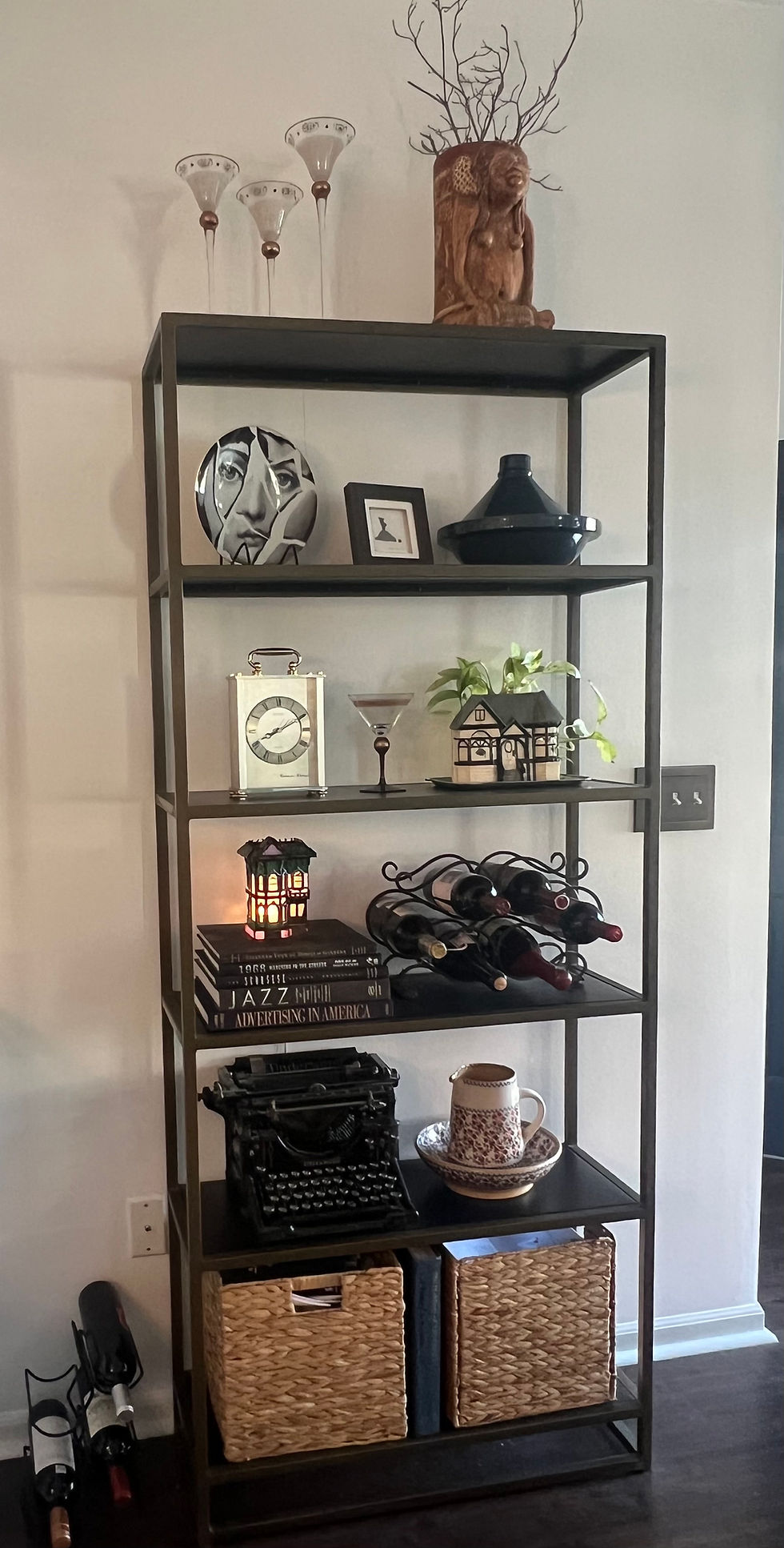
A replica of a Mayan vase I brought back from Belize, where I lived for months to ghostwrite a client's memoir. It holds twigs from several backyards of places we've lived.
A Moroccan tagine, my grandmother's porcelain planter, a gold-etched martini glass a friend gave me, a lighted Victorian house my uncle kept on his bureau — perched atop some of my favorite coffee table books. A 1917 typewriter that's as sculptural as it is dead heavy, and a pitcher and bowl I carried back in my luggage from Ireland.
None of it probably makes design sense. But it makes our home a reflection of us — then and now.
Designing space for my next chapter
One room in the house that is starkly different is the office. While nearly every other room is in tune with our combined taste — and honors Mike's innate sense of calm. The office captures the bolder, more adventurous side of my nature, at least at this point in my life. The word office is already a creative term for a 10 x 10 "spare" bedroom, which also must serve as a yoga-workout space and guest room, when absolutely necessary.
It was the most challenging space to tackle. First, because it had to accommodate so many functions. Second, because we inherited design features that prevented the room from being a blank slate.
The previous owners had visually cut the room in half by adding a chair rail and wainscoting, further accentuating the effect with paint: the darker charcoal paint on the lower walls and the mid-toned gray on the upper walls.
My design education urged me to remove the chair rail and paint the room a light color to maximize the illusion of spaciousness.

But that would mean spending more time than I had available. I had to get back to work. So, why not lean into the upper-lower situation — but go bold and bright?
Once my desk was placed along the long wall adjacent to the window, I realized I didn't want to stare at a void when looking up from the computer screen.
Why not gaze at an inspiring photo — one I had captured a few years ago in one of my favorite places in the world: Venice. Better yet: transform the photo into a mural that spans the entire upper wall. That's next.

Building a new life, not just a new home
Since my mother has been an integral part of our relocation — and worries about her health a major source of stress — it's fitting to include an update about her.
My mother made a full recovery after her bout with pneumonia — a remarkable feat for someone nearly 98 years old. And she was able to join us in Michigan just weeks after our arrival.

We often include her in explorations of our new area. Leaving the house and the unpacking for a few hours has proven to be as vital to our well being as any project at home.
Lake St. Clair is just down the street, and we visit often to watch the boats sail by. Or — in our version of stopping to smell the roses — catch a whiff of the fish being caught by locals dangling lines off the docks.
After moving so many times, my best advice is to act like a tourist, at least for awhile.
My home isn't finished — neither is my story
As another timeless proverb instructs: the only constant is change.
The key to thriving and not just surviving change is to remain more curious than anxious about it.
Moving presented a valuable moment for self-reflection — and transformation. The lessons I've learned have less to do with the logistics of moving and more about the psychology of reinvention.
It was also an opportunity to collaborate again with my life partner. There were times when we didn't think our marriage would survive another move. But it's actually strengthened our bond and renewed our commitment to each other.
As a life coach, I often remind clients that they're never finished evolving. I'm a testament to that.
Like our homes, we too are unfinished projects, ceaselessly engaged in the act of becoming.
Perhaps that's what momentum has been teaching me all along.
If you need help with anything that was shared in this blog, or want to share your thoughts, book a Discovery Call below. I'm here to listen and help you map your path forward.


https://hi88.soccer/ hôm trước thấy bạn bè nhắc nên mình bấm vào coi thử cho biết thôi. Mình không tìm hiểu sâu hay chơi gì, chủ yếu xem giao diện họ làm ra sao. Ấn tượng đầu là trang nhìn khá sáng sủa, bố cục không bị nhồi nhét nên lướt một vòng là hiểu đại khái. Mình để ý cái menu đặt khá dễ thấy, bấm chuyển qua lại mượt, không phải đoán xem nút nào đi đâu. Với lại nội dung trên trang chia thành từng khối riêng, nhìn cái là phân biệt được phần nào với phần nào, kéo xuống cũng không bị “lạc”. Nói chung kiểu trình bày gọn gàng, đọc nhanh vẫn theo kịp vì các…
hi88 mình thấy bạn bè nhắc hoài nên cũng bấm vào nghía thử cho biết, kiểu xem giao diện là chính chứ không có thời gian đọc kỹ. Vào cái là thấy trang làm khá thoáng, các phần tách thành từng khối riêng nên kéo xuống không bị rối. Mình để ý cái menu đặt ngay chỗ dễ nhìn, bấm qua lại giữa mấy mục cũng nhanh, không phải tìm vòng vòng. Mấy chỗ hiển thị thông tin dạng bảng cột nhìn gọn, lướt mắt cái là nắm được ý, không bị chữ dồn một cục. Nói chung cảm giác thân thiện, người mới vào cũng biết nên nhìn gì trước. Nhìn một vòng thì mình ấn tượng nhất là…
fly88 thấy bài nói về bản 2026 với “diện mạo mới” nghe thì cũng hơi nghi ngờ kiểu lại đổi tên đổi áo thôi, nhưng lướt thử thì đúng là cách họ chia nội dung theo khối nhìn gọn, mình tìm chỗ cần xem nhanh hơn hẳn. Menu đặt khá lộ. Bấm qua mấy mục chuyển trang cũng trơn, không kiểu đứng hình đợi load. Mình để ý phần tổng quan với mấy điểm nổi bật họ viết thành đoạn ngắn, đọc lướt vẫn nắm được ý. Vụ giao dịch nhanh ổn định nghe thì ai cũng nói, nhưng ít nhất cảm giác dùng không bị giật. Chắc do bố cục rõ ràng nên mình quen tay nhanh. Nhìn là…
https://rr88k1.com/ mình ghé vào xem thử cho biết vì thấy mọi người nhắc, chủ yếu tò mò giao diện thôi. Vừa mở lên là thấy trang sắp xếp khá thoáng, nhìn không bị rối hay “ngợp” như nhiều chỗ khác. Mình để ý thanh menu đặt ở vị trí dễ thấy nên bấm qua lại khá tiện, không phải kéo lên kéo xuống tìm. Mấy phần nội dung cũng chia theo khối rõ ràng, kiểu lướt nhanh vẫn nắm được đang ở mục nào. Nói chung cảm giác dùng ổn, hợp kiểu vào xem nhanh rồi thoát. Điểm mình thích nhất là các khối thông tin được canh gọn và menu nhìn khá trực quan ngay trên giao diện.
rr88 nghe cái kiểu “trang chủ chính thức 2026” là mình đã thấy hơi buồn cười rồi, vì mạng giờ cái gì cũng gắn mốc cho sang chứ thật ra mình chỉ quan tâm nó có dễ nhìn không. Vào thử thì ok, bố cục không kiểu nhồi chữ choáng ngợp, các khối nội dung đặt gọn gàng nên lướt xuống vẫn theo mạch, mắt đỡ phải đảo liên tục (mình thuộc dạng dễ rối khi gặp trang dài). Mình có đọc lướt đoạn giới thiệu lịch sử, họ ghi rõ nền tảng hoạt động từ 2018 và đặt trụ sở ở Philippines nên cảm giác thông tin có “đầu đuôi” hơn. Menu với tiêu đề từng box tách khá…